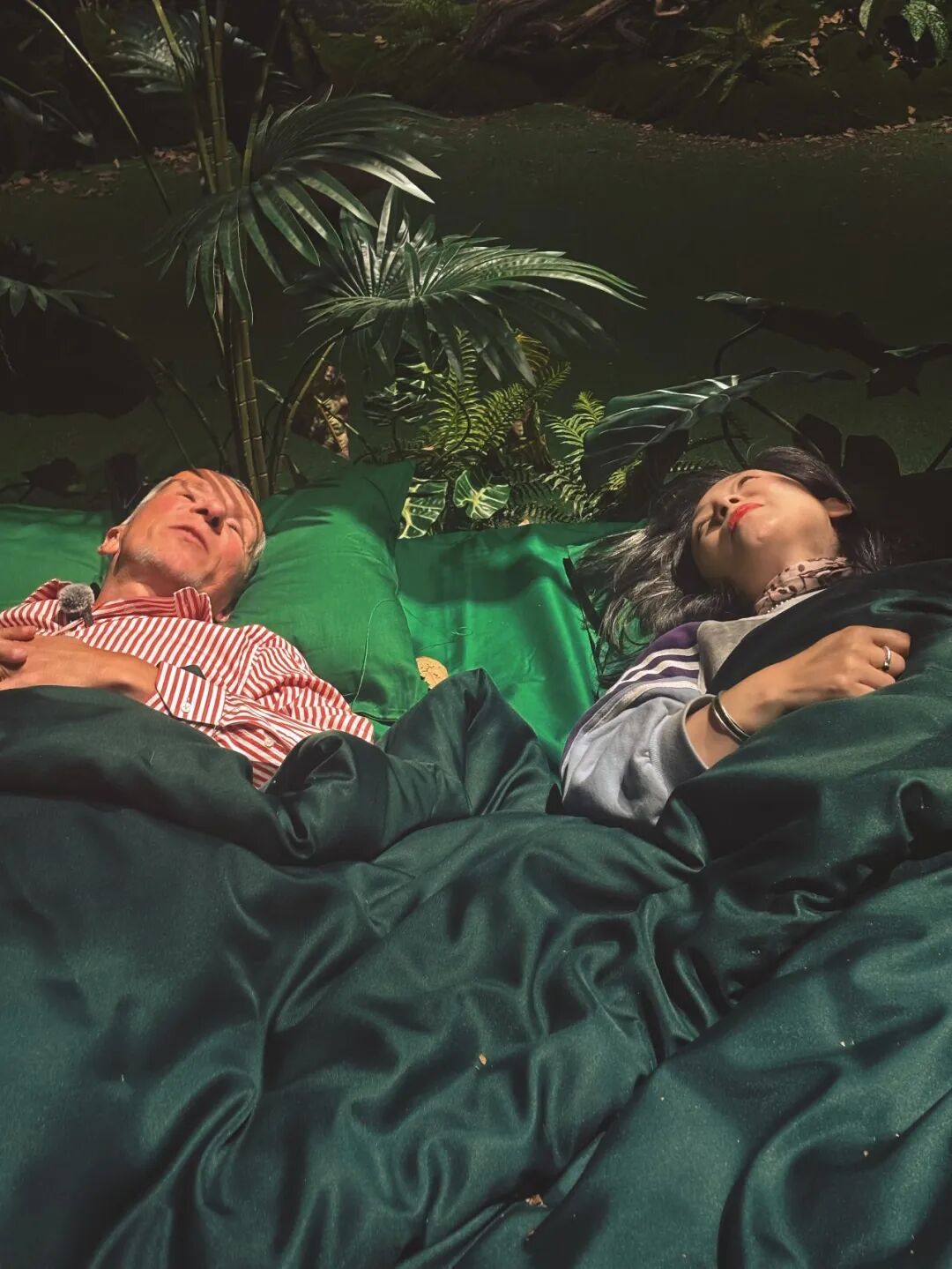
Intro: In an era where everyone is living life on “2x speed,” we usually hit up art museums just to snag that perfect Instagram shot within 60 minutes. But Martin Rendel says, “Hold on, just lie down first.” When BACKWALL met Martin and our guest curator/artist Ms. Zhao Huan on the 2nd floor of Chengdu Biennale’s Hall A, the conversation didn’t happen in some stuffy conference room. Instead, it kicked off on a massive, rustic, “natural” bed.
Video address: https://youtu.be/ptTKRzjZCus?si=nTlOLuoYjR7524Vz
Episode 1: The Dream Begins with a Total “Digital Detox”
Perched on that wooden bed in Area A1, surrounded by greenery and moving images, Martin dropped an invitation that might actually make most city dwellers a little anxious: “Go ahead, embrace boredom.”
As a curator who’s constantly hopping between Germany and China, Martin is pretty upfront about his own love-hate relationship with his iPhone. But he’s a firm believer that art shouldn’t just be pixels on a wall—it should be a “sensory sanctuary.”
“When I’m bored, that’s when my mind can go for a walk.”
That’s Martin’s logic: only when you unplug from all that information overload can you actually see the shadows of sunlight on the bedsheets, or hear the rhythm of your own breath.
Video address:https://youtu.be/_mN3QT4IygQ?si=W50-YUVYOCIPtipO
Episode 2: In 2055, Social Media Might Be History
Martin took us into a “digital forest” to show us his trilogy, To You in 30 Years. He asked his students to imagine life 30 years from now. Surprisingly, the answer from these digital natives was: “Get back to what’s real.”
- 1. To You in 30 Years (The Future of Work): It’s a vision of our lives in 2055—less about the grind, and more about finding space to breathe. As technology advances, we have more time than ever. Instead of chasing more distraction, we choose to “let go” and face the silence. It is a future where we move through a world that is finally at peace.
- 2. urg{end} (The Future of Connection): The Dessau students surprised Martin’s. They said, “By 2055, we want to ditch social media because it feels fake.” They’ve realized that choosing stillness is the ultimate status symbol. They want to embrace boredom, because only when the mind is bored does it gain the freedom to “go for a walk” and find its own meaning. Time is finally ours again.
- 3. Through the Myriad of Lights (The Future of Existence): In this “luminous world,” light doesn’t belong to machines, but to life itself. It’s a vision where every heartbeat is a lantern, and the city shimmer softly with the rhythm of existence. There is no border between the human and the digital; every being speaks through radiance, dissolving the fragile fences we once believed in. We walk slower and listen deeper, knowing our light reaches others as theirs reaches us.
Martin showed us a 150-meter-long rope piece to remind us: human civilization is just a tiny red speck at the very end of Earth’s history. In the face of nature, we’re all just passing through. So, what’s the rush?
Video address:https://youtu.be/LmL_1zwxTUk?si=SaBEBeZOegDXGVCI
Episode 3: At the Edge of the Black Hole—A Gentle Experiment in “Losing Control”
The final chapter of our talk went down in the darkest part of the gallery, Area 8—the “Black Hole.”
There are only two pieces here. Martin says he built this space to help visitors “clean their heads.” After seeing hundreds of loud, busy artworks, you need to hit the “reset” button here.
What’s most touching is Martin’s respect for “disorder.” In an art museum world that’s usually obsessed with precision and control, he’s actually chasing a “place of anarchy.”
“I don’t want full control, because a lot of the beautiful things in life happen when you lose control.”
When 15,000 visitors leave behind their breath, their footsteps, and their traces in the gallery, that’s when the artwork is finally finished. It doesn’t belong to the artist anymore; it belongs to everyone who spent a moment there.
Outro: Why “BACKWALL”?
As the interview wrapped up, Martin was curious about the name “BACKWALL.”
Tan Xiaozheng told him: “Because art always has a wall that people don’t see. We want to take everyone to see the truth behind that wall.”
Martin cracked a big smile and said it’s just like “behind the scenes” in the movies—the most fascinating part. His hope is that everyone who watches the videos or visits the show takes home more than just photos on their phone. He wants the art to stay with them like a seed—in their minds, or even “stuck in their hair.”
发表回复