作者: admin

  • Heading: After “Chilling Out” at the Biennale, Zhao Huan and German Curator Martin Talk Boredom in 2055.

    Heading: After “Chilling Out” at the Biennale, Zhao Huan and German Curator Martin Talk Boredom in 2055.

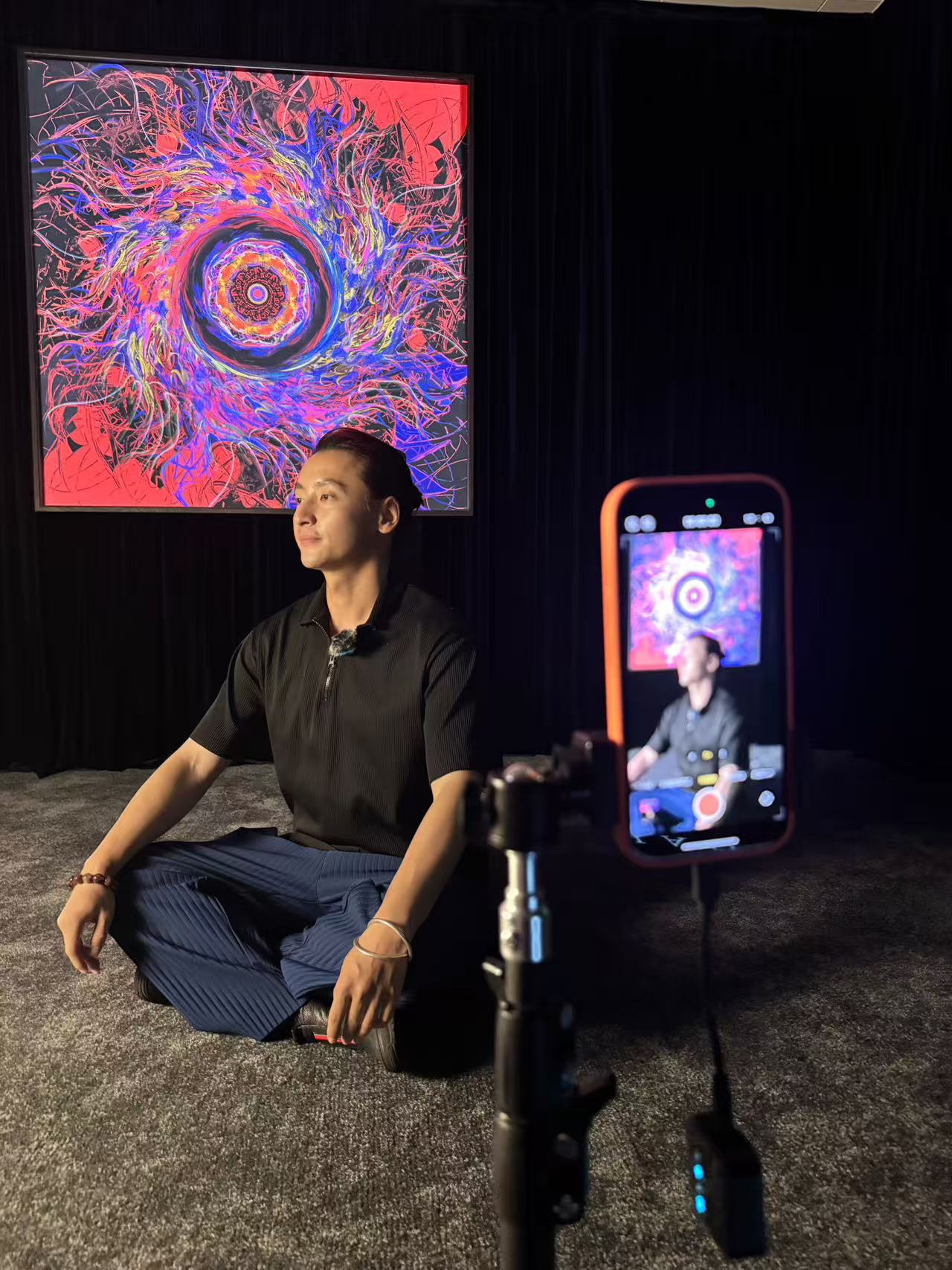
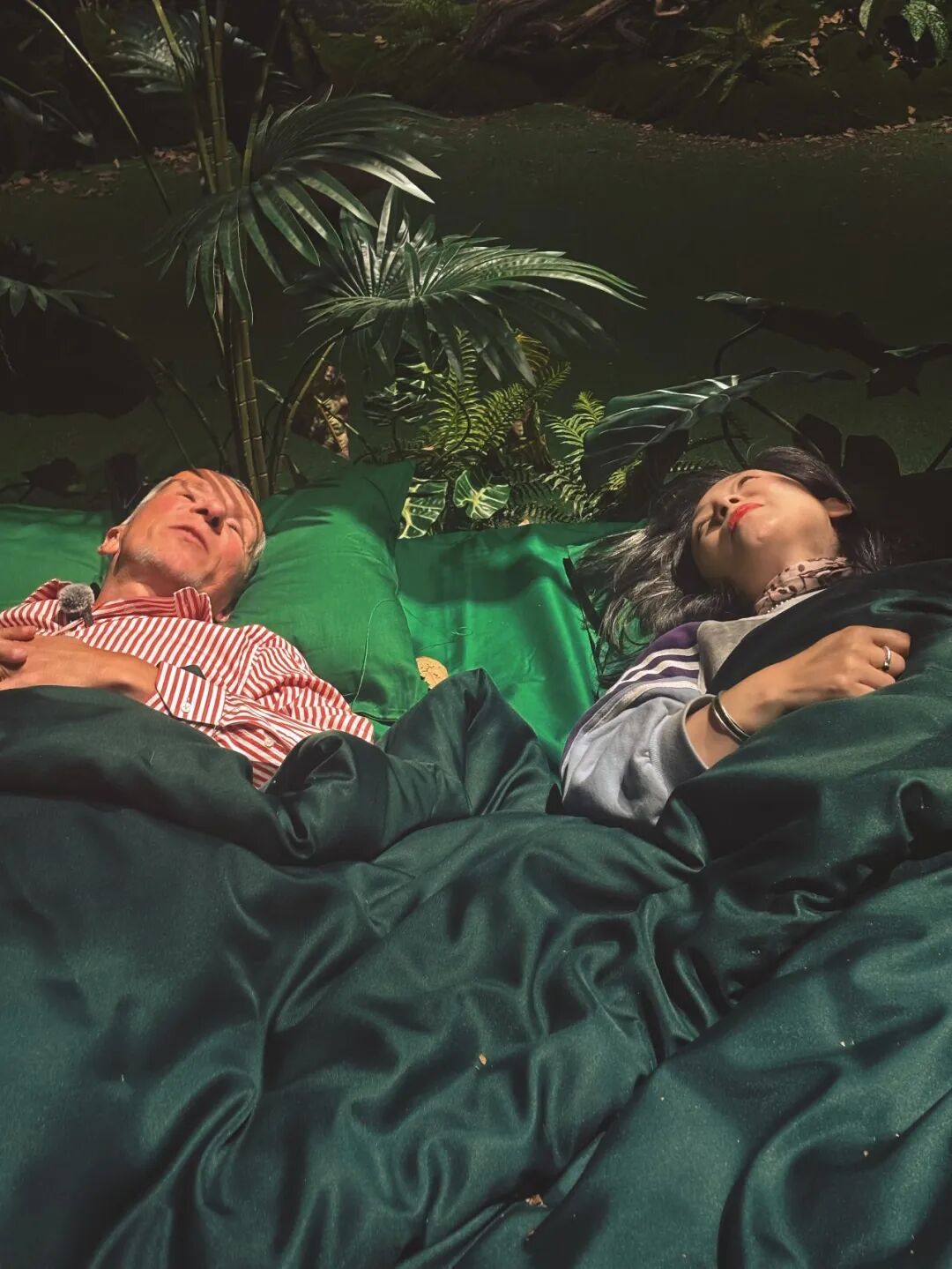
    Intro: In an era where everyone is living life on “2x speed,” we usually hit up art museums just to snag that perfect Instagram shot within 60 minutes. But Martin Rendel says, “Hold on, just lie down first.” When BACKWALL met Martin and our guest curator/artist Ms. Zhao Huan on the 2nd floor of Chengdu Biennale’s Hall A, the conversation didn’t happen in some stuffy conference room. Instead, it kicked off on a massive, rustic, “natural” bed.

    Video address: https://youtu.be/ptTKRzjZCus?si=nTlOLuoYjR7524Vz

    Episode 1: The Dream Begins with a Total “Digital Detox”

    Perched on that wooden bed in Area A1, surrounded by greenery and moving images, Martin dropped an invitation that might actually make most city dwellers a little anxious: “Go ahead, embrace boredom.”

    As a curator who’s constantly hopping between Germany and China, Martin is pretty upfront about his own love-hate relationship with his iPhone. But he’s a firm believer that art shouldn’t just be pixels on a wall—it should be a “sensory sanctuary.”

    “When I’m bored, that’s when my mind can go for a walk.”

    That’s Martin’s logic: only when you unplug from all that information overload can you actually see the shadows of sunlight on the bedsheets, or hear the rhythm of your own breath.

    Video address:https://youtu.be/_mN3QT4IygQ?si=W50-YUVYOCIPtipO

    Episode 2: In 2055, Social Media Might Be History

    Martin took us into a “digital forest” to show us his trilogy, To You in 30 Years. He asked his students to imagine life 30 years from now. Surprisingly, the answer from these digital natives was: “Get back to what’s real.”

    • 1. To You in 30 Years (The Future of Work): It’s a vision of our lives in 2055—less about the grind, and more about finding space to breathe. As technology advances, we have more time than ever. Instead of chasing more distraction, we choose to “let go” and face the silence. It is a future where we move through a world that is finally at peace.
    • 2. urg{end} (The Future of Connection): The Dessau students surprised Martin’s. They said, “By 2055, we want to ditch social media because it feels fake.” They’ve realized that choosing stillness is the ultimate status symbol. They want to embrace boredom, because only when the mind is bored does it gain the freedom to “go for a walk” and find its own meaning. Time is finally ours again.
    • 3. Through the Myriad of Lights (The Future of Existence): In this “luminous world,” light doesn’t belong to machines, but to life itself. It’s a vision where every heartbeat is a lantern, and the city shimmer softly with the rhythm of existence. There is no border between the human and the digital; every being speaks through radiance, dissolving the fragile fences we once believed in. We walk slower and listen deeper, knowing our light reaches others as theirs reaches us.

    Martin showed us a 150-meter-long rope piece to remind us: human civilization is just a tiny red speck at the very end of Earth’s history. In the face of nature, we’re all just passing through. So, what’s the rush?

    Video address:https://youtu.be/LmL_1zwxTUk?si=SaBEBeZOegDXGVCI

    Episode 3: At the Edge of the Black Hole—A Gentle Experiment in “Losing Control”

    The final chapter of our talk went down in the darkest part of the gallery, Area 8—the “Black Hole.”

    There are only two pieces here. Martin says he built this space to help visitors “clean their heads.” After seeing hundreds of loud, busy artworks, you need to hit the “reset” button here.

    What’s most touching is Martin’s respect for “disorder.” In an art museum world that’s usually obsessed with precision and control, he’s actually chasing a “place of anarchy.”

    “I don’t want full control, because a lot of the beautiful things in life happen when you lose control.”

    When 15,000 visitors leave behind their breath, their footsteps, and their traces in the gallery, that’s when the artwork is finally finished. It doesn’t belong to the artist anymore; it belongs to everyone who spent a moment there.

    Outro: Why “BACKWALL”?

    As the interview wrapped up, Martin was curious about the name “BACKWALL.”

    Tan Xiaozheng told him: “Because art always has a wall that people don’t see. We want to take everyone to see the truth behind that wall.”

    Martin cracked a big smile and said it’s just like “behind the scenes” in the movies—the most fascinating part. His hope is that everyone who watches the videos or visits the show takes home more than just photos on their phone. He wants the art to stay with them like a seed—in their minds, or even “stuck in their hair.”
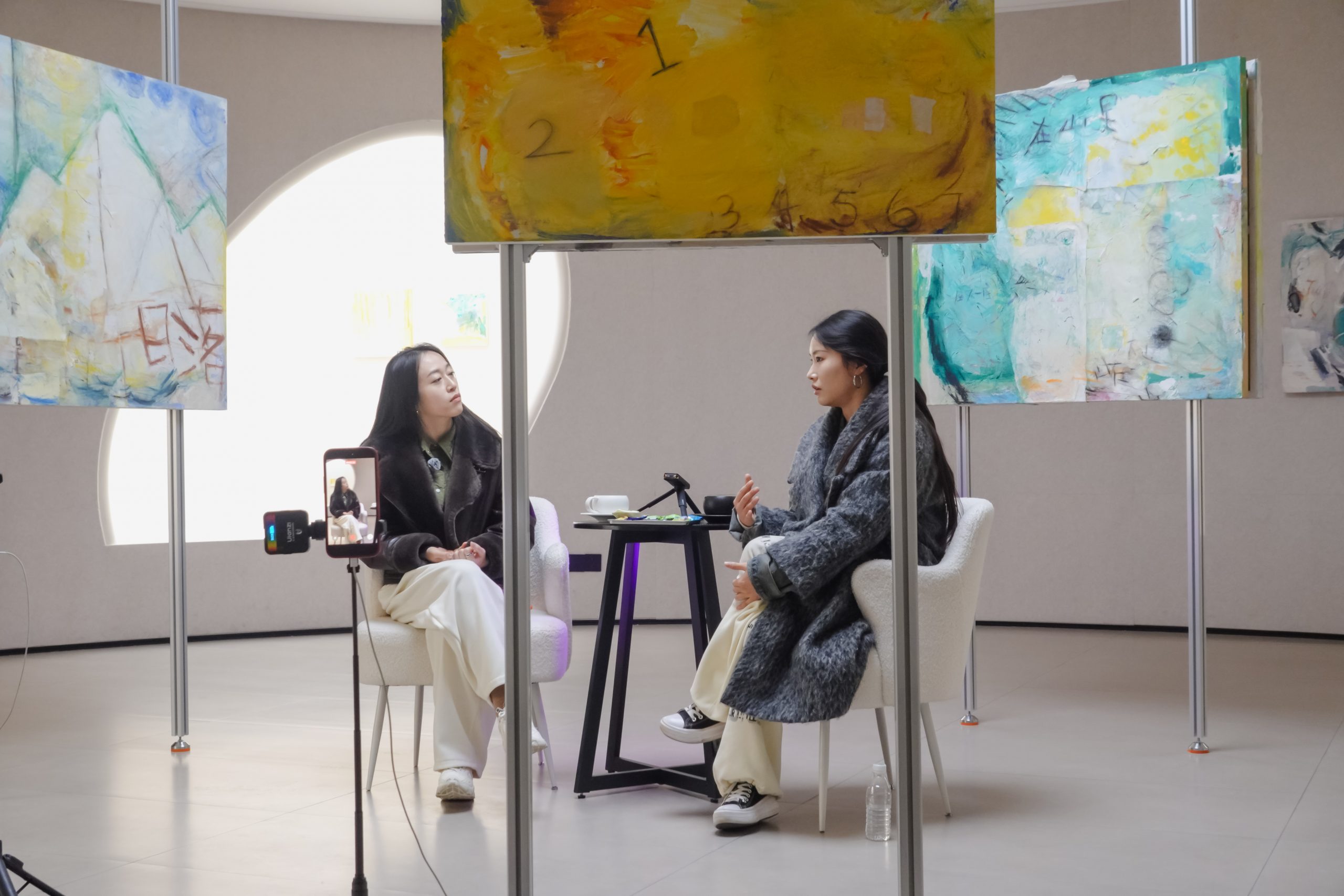
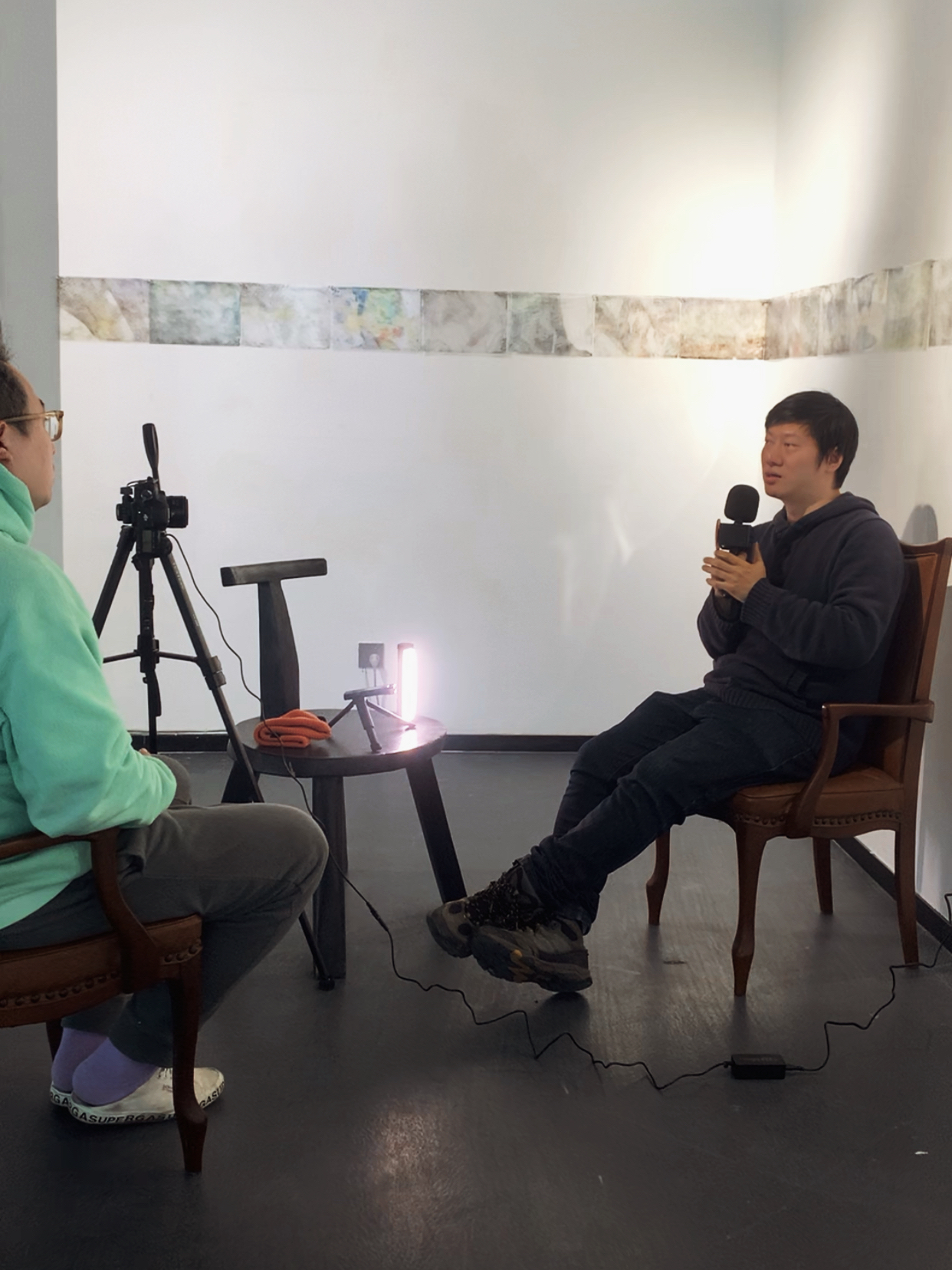
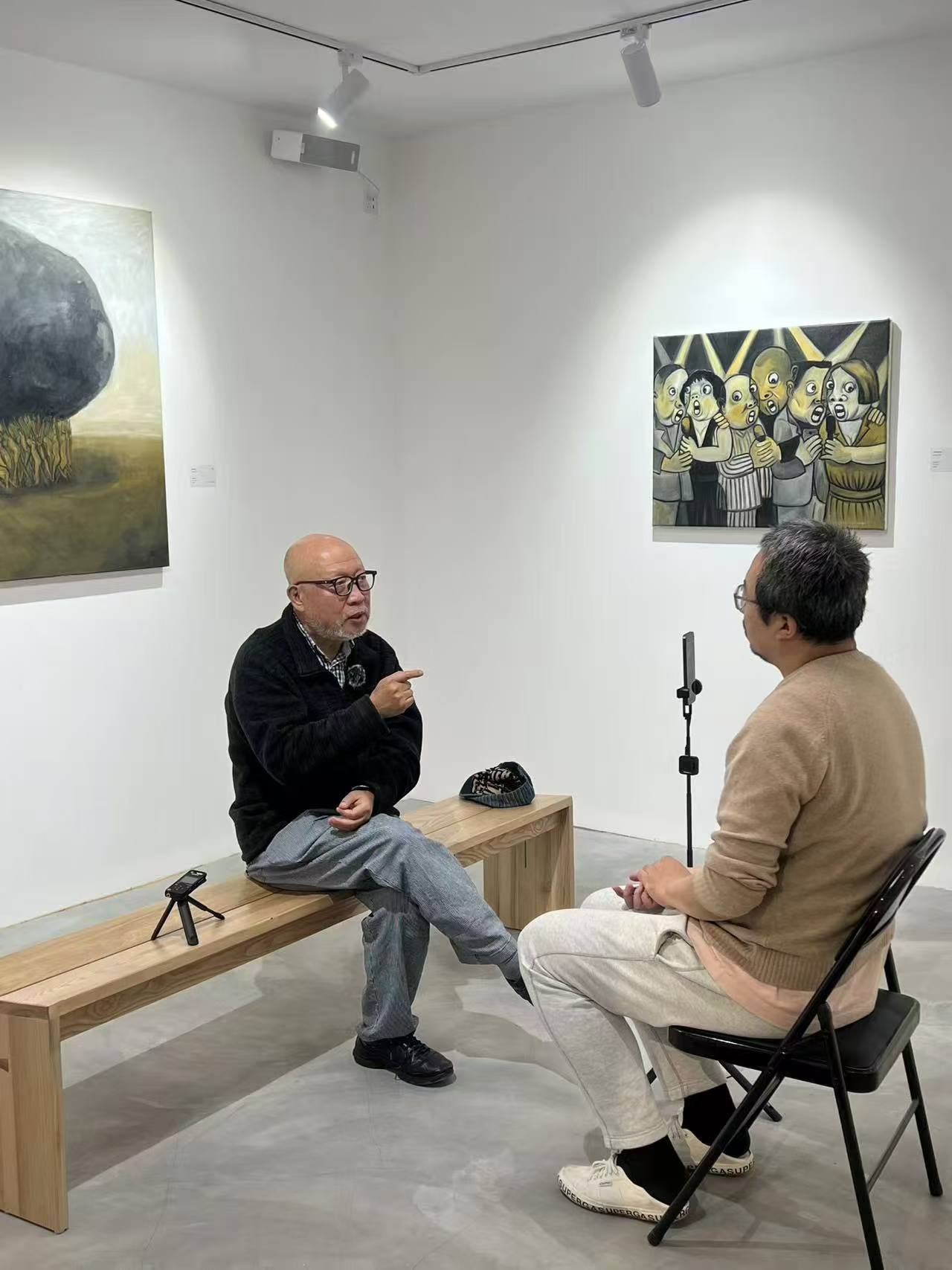
  • Kaili Shangguan × Jingli Gou | A Conversation Before Becoming Oneself

    Kaili Shangguan × Jingli Gou | A Conversation Before Becoming Oneself

    Date: January 29, 2026
    Location: About Time Art Space, Chengdu
    Exhibition: “Hey, Walk a Little Further In” — Jingli Gou Solo Exhibition
    (Jan 11 – Mar 2, 2026)

    This wasn’t a conversation designed in advance.

    It felt more like an open working session—one that was allowed to happen.
    The discussion didn’t always move forward in a straight line, and the speakers weren’t in a rush to reach conclusions. There were pauses, hesitations, moments of checking back: Did I really say what I meant?

    BACKWALL chooses to document moments like these, rather than polish them into something smoother.


    A Solo Exhibition Is Not Ambition — It’s Timing

    For Jingli Gou, this was her first solo exhibition presented entirely as an individual.

    Yet at the beginning of the conversation, she didn’t frame it as a “breakthrough” or a “milestone.” Instead, she described it with a calm sense of judgment: the body of work was ready, the phase had arrived, so the exhibition happened naturally.

    The real pressure didn’t come from the work itself, but from what starts once an exhibition becomes a functioning system—catalog production, layouts, posters, communication, endless confirmations. These tasks aren’t creation, but they are very real parts of an artist’s daily labor.

    After the exhibition opened, she didn’t rush into the next output. She chose to pause and process the feedback—both the positive and the critical. Over time, these responses settle, shaping what comes next.

    It’s a rhythm that doesn’t hurry forward.


    “Style” Is Not What She’s Concerned With

    When the conversation turned to how artistic style is formed, Gou’s response resisted familiar narratives.

    She doesn’t see style as something that needs to be deliberately constructed. For her, what people call “style” is simply what emerges naturally when she works from her own perspective, over time.

    More than how to paint, she cares about what she is trying to say.

    She wants to use language that feels as truthful as possible, to communicate the questions she’s genuinely thinking through—and to create a shared space of recognition with viewers. Not persuasion, but resonance.

    This also explains the recurring use of text in her work. Words aren’t decorative; they step in when images alone can’t carry enough clarity. They become a necessary intervention.


    An Exhibition as Training in Connection

    As a curator and the founder of AVG Space, Kaili Shangguan consistently positioned herself as a companion rather than a judge throughout the conversation.

    She wasn’t focused on evaluating how “complete” the work was. Instead, she spoke about exhibitions as public events—spaces where artists learn how to connect with the outside world.

    In her view, an exhibition is a form of communication training. Feedback isn’t always gentle, but it exists—and it needs to be received, filtered, and understood.

    She also made it clear that intermediaries in today’s art ecosystem are not redundant. Whether curators, agents, or art spaces, these roles aren’t meant to replace the artist’s voice, but to protect artists from being overextended and consumed.


    Where Two Experiences Meet

    What truly happened in this conversation wasn’t a clash of viewpoints, but a quiet alignment of experience.

    One participant stands at the intersection between graduation and a necessary period of creative incubation; the other has long worked alongside young artists, paying close attention to psychological structures and systemic support. Their understanding of instability was remarkably similar.

    Neither felt the need to prove anything quickly. Neither treated an exhibition as a final outcome, but rather as one node in a longer creative path.

    This shared understanding wasn’t loudly declared—it surfaced naturally in the details of the exchange.


    BACKWALL’s Position

    As a documentarian, BACKWALL does not attempt to become the center of the conversation.

    But its position is clear: a resistance to hollow art rhetoric, and a refusal to reduce artistic ecosystems to traffic metrics or commercial outcomes. The value of new media lies not only in monetization, but in long-term documentation, archival presence, and historical meaning.

    Someday, when these materials are revisited, they may serve as important clues for understanding how creative practices took shape in this moment.


    Unfinished Is the Most Honest State

    This conversation did not produce definitive answers.

    What it reveals instead is an ongoing condition—how one becomes oneself, and how patience is maintained within real-world systems.

    Perhaps that’s exactly why it deserves to be recorded.


    Coming Soon | A Series of Short Conversation Films

    The full BACKWALL conversation is currently being edited into a series of short videos.

    Through moving images, you’ll see details that text can’t fully capture: pauses, hesitations, moments of laughter—things that resist being turned into neat “key takeaways.”

    This isn’t a set of summarized lessons, but a conversation still in progress.

    The video series will be released on BACKWALL’s WeChat Video Channel and Xiaohongshu. Stay tuned.

    If you care about how art is actually made in real conditions—not just how it’s discussed—this conversation may be worth continuing to watch.

  • Shaoyan Yu: Becoming an Artist in the Cracks of Time

    Shaoyan Yu: Becoming an Artist in the Cracks of Time

    Shaoyan Yu never rushes to define himself.

    At the beginning of the interview, he makes one thing clear first: “Let’s not make it too serious.”
    He is not good at producing punchlines, nor is he interested in turning his practice into a grand statement. Instead, he prefers to start from lived experience—when he left, where he stayed, and how he slowly arrived at where he is now.

    I. A Timeline: A Path Without Smooth Curves

    Born in 1989 in Yichang, Hubei, Shaoyan Yu received rigorous training in traditional art at an early stage.

    From 2007 to 2011, he studied calligraphy in the Chinese Painting Department at Hubei Institute of Fine Arts, a system rooted in brushwork, structure, and patience.

    “I was trained in traditional art—calligraphy and painting. I’m very sensitive to materials and tactility.”

    After graduation, instead of following an expected trajectory, he chose to leave.

    In 2012, Yu moved to Germany, beginning an eight-year period of study and life abroad.
    During this time, he first studied German, then shifted his focus to photography, completing both undergraduate and postgraduate studies in the field.

    His education there did not emphasize a single stylistic direction, but rather continuous experimentation.

    “During my undergraduate years, we learned everything—darkroom, film, portrait, documentary, even cinema. Every semester I took classes from different professors.”

    This open structure gradually led him to a realization:
    Photography was not merely image-making, but a medium that could enter the system of contemporary art.

    “That’s when I knew I wanted to become a contemporary artist, not just a photographer.”

    In 2020, after completing his postgraduate studies, he returned to China and began his own entrepreneurial path.
    In 2021, he established Shaoyan Yu Art Studio in Shanghai.

    The early years after returning were not easy.

    “I was pretty lost at first. I spent two years as a freelance artist, attending events everywhere, with unstable income, constantly losing money.”

    II. From Artist to Curator: A Turn Shaped by Reality

    A real turning point came when Yu became deeply involved in exhibition operations.

    For a period of time, he participated directly in the daily running of a gallery—handling everything from curatorial work to execution, from artist communication to on-site installation.

    “That year, I did everything—curator, manager, even service staff. The whole gallery was basically run by me alone.”

    It was not romantic, but it was decisive.

    “That year changed my life. I realized that creation wasn’t the only thing I could do.”

    From then on, his working method became clearer:
    Alongside personal creation, he built a sustainable path through curating, exhibition organization, and art event production.

    Today, he works simultaneously in three roles:
    artist, curator, and art project organizer.

    “I can’t give up being an artist, but I also need a way to survive.”

    III. Time as a Continuing Core Theme

    In Yu’s artistic practice, “time” is a recurring subject.

    Yet it is not linear or narrative time, but something perceived, misremembered, and constantly altered.

    In his recent exhibition The Cracks of Time in Chengdu, he experimented with a more abstract approach to image-making.

    “I want to talk about the authenticity of images. What we remember may be real, or it may already have been altered by memory.”

    The works unfold in layers:
    documentation of the real world, material translation, and finally a “virtual image” that is little more than a shadow.

    “When you realize you might be deceived—by others or even by your own memory—you start to question whether the world we live in is entirely real.”

    For Yu, art does not resolve this doubt.

    “I just present this state and let it remain there.”

    IV. Neither Catering to the Audience Nor Avoiding Reality

    Yu is fully aware that different spaces and cities receive works differently.

    “If it’s a museum, I’ll explain things more clearly. In a composite space, I allow the work to be more experimental.”

    He does not aim for universal readability.

    “Simple documentation is fine, but I want to process images one more time. Once it becomes a conceptual image, what you shoot is no longer that important.”

    This explains his constant movement between photography, materials, and installation.
    What matters to him is how images are understood, not which medium they belong to.

    V. Continuing to Work Within the Cracks

    At the end of the interview, Yu does not speak of success or ultimate goals.

    He talks instead about what remains to be done: new chapters, new exhibitions, new modes of collaboration.

    “I’ll continue making new series and presenting them slowly through exhibitions.”

    For him, art is not a final statement, but a long-term process of organizing one’s own experience.

    The cracks will not disappear, and time will not stop.

    All he can do is continue working within them.

  • Part I | HistoryOne Day, One World | Asian Graphic Design Beyond the AlgorithmPart I | History

    Part I | HistoryOne Day, One World | Asian Graphic Design Beyond the AlgorithmPart I | History

    Part I | History

    From 1978 to Today: How JAGDA Turned “Design” into a System

    In 1978, the Japan Graphic Designers Association (JAGDA) was founded.

    It was a time when the Cold War had yet to end, when industry and mass media were expanding at an unprecedented pace, and when graphic design was still largely understood as a professional skill closely tied to print and information transmission.

    Forty-eight years later, as generative AI begins to mass-produce images at extraordinary speed, JAGDA continues to publish its annual yearbook, present awards, and organize touring exhibitions.
    This seemingly “slow” system has, in fact, become the most solid foundation of Japanese graphic design.

    The JAGDA Yearbook is not a simple annual compilation. It is a continuously evolving design archive that asks:

    • Which questions are repeatedly examined?
    • Which methods are constantly revised?
    • Which designs truly enter the social sphere?

    The JAGDA Award is selected from within this system. It does not emphasize individual genius, nor does it chase short-term stylistic trends. Instead, it addresses a long-term question:

    How can design continue to exist as a form of social practice?

    From Shanghai to Guangzhou, and now to Chengdu, the China tour is not a one-way cultural export. It is a juxtaposition of historical experiences.

    While Chinese design is still in a phase of rapid expansion, Japanese design has already entered a stage focused on how to sustain judgment.


    Part II | Comparison

    Chinese Design vs. Japanese Design: The Gap Is Not Aesthetic, but Structural

    At the JAGDA Yearbook Exhibition, one of the most common misunderstandings is the idea that:

    “Japanese design is more advanced.”

    In reality, if we speak purely in terms of visual quality, Chinese design is by no means weak.

    The real difference lies in how design is organized, sustained, and continuously evaluated.

    Japanese design—particularly works within the JAGDA framework—often shares a consistent underlying characteristic:

    Judgment precedes form; structure precedes expression.

    Every visual decision can be traced back to the core problem it seeks to address.

    Chinese design, by contrast, excels at responding quickly to complex conditions, creating strong visual impact, and fulfilling commercial objectives.

    The issue is that speed rarely translates into stable, long-term methodology.

    As algorithms continue to accelerate visual production, the challenge facing Chinese design is not technological inferiority, but rather the dilution of judgment.

    What the JAGDA Awards present is not an answer, but a reminder:

    When everyone is chasing faster, stronger, and more eye-catching results,
    slowing down to build one’s own design system may become the next true competitive advantage.


    Part III | The Present

    In the Age of Algorithms, What Is Left for Designers?

    “One Day, One World: The JAGDA Yearbook Exhibition” does not attempt to provide definitive answers about the future.

    Instead, it deliberately creates a sense of unease:

    When image generation becomes so effortless, is design losing its meaning?

    In the exhibition’s Asian Graphic Design Dialogue Film section, 25 groups of Asian creators from different cities discuss issues that go far beyond technical skill:

    • Some reflect nostalgically on the golden age of graphic design.
    • Some confront the anxiety brought about by generative AI.
    • Others speak candidly about the confusion and hesitation of being a middle-aged creator.

    These conversations do not seek consensus. They preserve uncertainty.

    At the same time, the Issay Kitagawa section offers another point of reference—

    A design path that does not cater to mainstream taste, does not prioritize easy readability, and consistently begins with materials, printing processes, and the physical conditions of the site.

    This approach is not efficient, but it maintains a bodily and material connection to the real world.

    Through this contrast, the exhibition continually reminds us:

    When visual output can be mass-produced,
    judgment, responsibility, and an understanding of reality become the final values of design.


    Exhibition Information | Chengdu

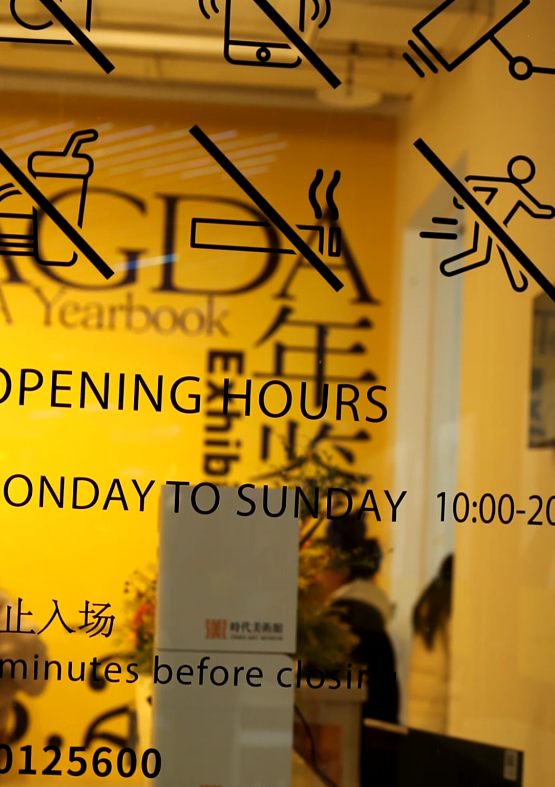
    One Day, One World: The JAGDA Yearbook Exhibition

     January 10 – March 22, 2026
    (Open daily, 10:00–20:00)

     Times Museum · Chengdu

    Note: Ticket information is available through official channels.

  • The Logic of the Absurd and the Weight of the Times:Tutou Juren at Faun Gallery

    The Logic of the Absurd and the Weight of the Times:Tutou Juren at Faun Gallery

    Artist: Tutou Juren (Li Xiaoqiang)
    Exhibition: Nov. 15 – Dec. 6, 2025
    Venue: Faun Gallery, Chengdu

    1. Personal History Meets Art History

    Tutou Juren—real name Li Xiaoqiang—has one of those life stories that naturally spills into his art. Born in 1963 in Tieling, educated at the Lu Xun Academy of Fine Arts, he’s lived through several major cultural shifts: the openness of the 1980s, the entrepreneurial chaos of the 1990s, the early-2000s blogging boom, and the visual-first world of today’s social media.

    All these phases stack together, and you can feel them in his work.
    His visual language—the exaggeration, the humor, the absurdity—didn’t come from following a school or movement. It came from living through multiple eras, each with its own contradictions.

    As he puts it:

    “I don’t match anything out there. I’m just me.”

    Surprisingly simple, but it sums up exactly why his style is so hard to categorize.

    1. The Echoes of the ’85 New Wave

    When Li was studying at Lu Xun Academy in the mid-80s, China’s art world was waking up. The ’85 New Wave was reshaping everything, and art students were suddenly exposed to ideas, images, and cultural references they’d never seen before.

    He remembers that time as a period full of energy:

    “Every day something new was happening. It felt like anything was possible.”

    That sense of openness didn’t just shape his worldview—it planted the seed for the kind of self-driven expression that later became central to his work.

    1. Blogging: Where His Absurd Universe Began

    Between 2003 and 2006, Li went through a difficult chapter—life stalled, family issues piled up, and he felt lost. So he turned to blogging. He wrote novels, essays, scripts—close to a million words in total.

    Ironically, what brought him back to visual art wasn’t ambition, but a simple internet truth:

    “Write 3,000 words, barely anyone reads it. Post a drawing, boom—hundreds of likes.”

    It wasn’t about vanity; it was clarity. Images communicate fast. People connect instantly.
    And from his blog doodles, the first versions of his now-iconic “Little Yellow Man” characters began to appear. What started as casual sketches slowly grew into a fully formed personal visual system.

    1. Why He Calls Himself “Absurdist”

    Li’s “Absurdist” label isn’t a gimmick. It reflects how he processes the world. His characters are exaggerated, distorted, naive, cynical, humorous, and strangely honest.

    Most importantly:
    he always paints himself.

    That choice matters. It means the humor and critique in his work never feel like he’s attacking someone else. The absurdity is a mirror, not a weapon. And because the “self” becomes a universal placeholder, his work opens up room for viewers to project their own interpretations.

    1. The Medium Shift: From Ink to Blogs to Oil Paint

    Li’s career moves through clear media phases:
    • early ink drawings → raw, impulsive expression
    • blogging → narrative structure and storytelling
    • oil painting → deeper emotional and visual complexity

    He explains the change simply:

    “Oil painting holds more. It carries the absurd better.”

    Oil allows him to layer emotions, contradictions, and visual density in a way that ink or digital sketches couldn’t. His current practice feels like the fullest version of his inner world so far.

    1. Why So Many Characters Wear Hospital Gowns

    If you look closely, a lot of his recent figures wear hospital outfits.
    The reason? Surprisingly logical:

    “Regular clothes make people think the painting’s about them. Hospital gowns make everything make sense.”

    It’s funny, but it’s also real.
    The hospital gown becomes a way to neutralize identity—everyone becomes vulnerable, strange, and strangely relatable. It also adds a layer of emotional truth: in a shifting, uncertain era, who hasn’t felt a bit like a patient waiting for something to make sense?

    1. An Artist Outside the Art-World Bubble

    Li doesn’t live in Beijing or Shanghai, doesn’t “play the scene,” and doesn’t rely on relationship networks. In his words:

    “This is a society built on connections. I just don’t play that game.”

    His independence keeps his work raw, unfiltered, and free of the politics and trends that often shape contemporary art circles.

    1. The IP Question: Potential vs. Reality

    Li’s visual system is incredibly consistent—and yes, extremely IP-ready. He knows this.
    But he also knows how commercial IP really works:

    “To build an IP, you don’t need two shovels. You need an excavator.”

    To him, it’s not about printing T-shirts or toys. Real IP development takes real infrastructure: funding, branding, strategy, distribution. He’s open to collaboration, but he wants the right partner—one who can scale the world he’s built, not flatten it.

    1. Art as Attitude and Temperature

    Li has a sharp eye for social issues, but he’s not confrontational. His stance is gentle but firm:

    “We can’t change society. But we can express our attitude and our temperature.”

    That “temperature” is crucial.
    His work isn’t cold irony—it’s warm, human absurdity. The kind that tells you:

    We’re all struggling. We’re all ridiculous.
    And somehow, that’s what makes us real.

    Closing:

    Absurdity as a Way of Being**

    At Faun Gallery, Li’s yellow-and-black figures, distorted faces, and drifting emotions create a world that feels both surreal and painfully honest.

    He’s not following any movement.
    He’s not trying to shock.
    He’s not building a brand or chasing trends.

    He’s simply expressing what it feels like to be a person living through shifting eras—and doing it with humor, self-reflection, and a stubborn commitment to authenticity.

    In a time when images move fast and attention moves faster, Tutou Juren offers something rare:
    a visual language that speaks directly, honestly, and with just the right amount of absurdity to make truth easier to face.

  • The Art World Is a Scam and the Fight for Sincerity: An Interview with FAUN Gallery Owner Hunter Charles

    The Art World Is a Scam and the Fight for Sincerity: An Interview with FAUN Gallery Owner Hunter Charles

    Right in the heart of Chengdu, Hunter Charles’ FAUN Gallery quietly stands on an old street. Unlike the high-end galleries in commercial districts, there’s no glittering lights or champagne receptions here—only a sense of honesty and warmth.

    Hunter, a gallery owner from Los Angeles, came to China with nothing but “a backpack and a dream.” His goal: to help more people in the West see the vitality and complexity of contemporary Chinese art.

    Why He Came to China

    Hunter recalls that his decision to come to China was partly instinct, partly ambition.

    “China is the world’s second-largest economy, full of potential in both production and buying power. More importantly, I wanted to help talented Chinese artists—those who are underrecognized internationally—get the attention they deserve.”

    But what made him stay was Chengdu itself.

    “The city is full of color, culture, and calm. The rhythm of life here is gentle. The landscapes, the people, the food—it’s all alive. In the West, we’re often taught that China lacks freedom or creativity, but what I’ve seen in Chengdu is the total opposite. The artists here are incredibly smart and brave, always pushing the limits of expression.”

    From Accountant to Gallerist

    Before running a gallery, Hunter was an accountant—making good money but feeling completely empty.

    “I thought I’d spend my whole life behind a computer until COVID hit. Working from home nearly broke me. One day I told my dad, ‘I can’t do this anymore.’”

    So he took everything he’d learned about business and invested it into what he truly loved—art.

    “I started my first gallery with my own savings. No investors, no backers. I just wanted to show good art, and let the work speak for itself.”

    “The Art Industry Is a Scam”

    Hunter doesn’t hold back when talking about the art world.

    “The art industry, at its core, is a scam. Whether it’s art schools, auction houses, or major museums—they’re all driven by capital. Art has become a bar of gold traded among the rich, not an expression of the soul. I don’t hate money, but I hate hypocrisy.”

    He adds,

    “Too many art events are just social gatherings where people only care about swapping WeChat contacts or taking photos. Real conversations about art are becoming rare.”

    Searching for ‘Real Art’ in Chengdu

    FAUN Gallery sits across from People’s Park on an old street that Hunter calls “the real China.”

    “I didn’t want to open in a luxury mall or a trendy district. I wanted a place with real life around it—grandparents, kids, food stalls. That’s where culture grows.”

    He says the young artists he’s met here have deeply inspired him.

    “They’re not trapped by systems or obsessed with fame. Their work is honest, emotional, and thoughtful. That’s what art should be.”

    On ‘Guanxi’ and the Social Scene

    Hunter also has strong opinions about relationship culture, or guanxi:

    “Whether in China or America, the art world is tangled up in connections and power games. People care more about what you can offer than who you are.
    I’m not here to please anyone—I’m here to break that cycle and bring art back to art.”

    On Controversy and Public Judgment

    Hunter has faced online criticism and personal attacks, but he remains calm about it.

    “I’m not perfect, and I’ve never claimed to be. I’ve made mistakes, but I’ve grown from them. I don’t waste my time arguing online. My shows and my work speak for me.”

    China and the West: Different Art Worlds

    When it comes to comparing art markets, Hunter is clear:

    “China’s art market is still shaping its own identity—it doesn’t need to copy the West.
    China has its own cultural spirit. I just hope to see more support for everyday artists, not just the names that keep appearing in the elite system.”

    Epilogue: The Sincerity of Art

    At the end of the interview, Hunter spoke about his long-term commitment:

    “I may never be Chinese, but I’ll give all my time and passion to show great art.
    Even if one day FAUN no longer exists, I hope people remember that there was a foreigner in Chengdu who tried to show something real.”

    Hunter smiled and added,

    “Art shouldn’t be a bar of gold—it should be a mirror that reflects the human soul.”

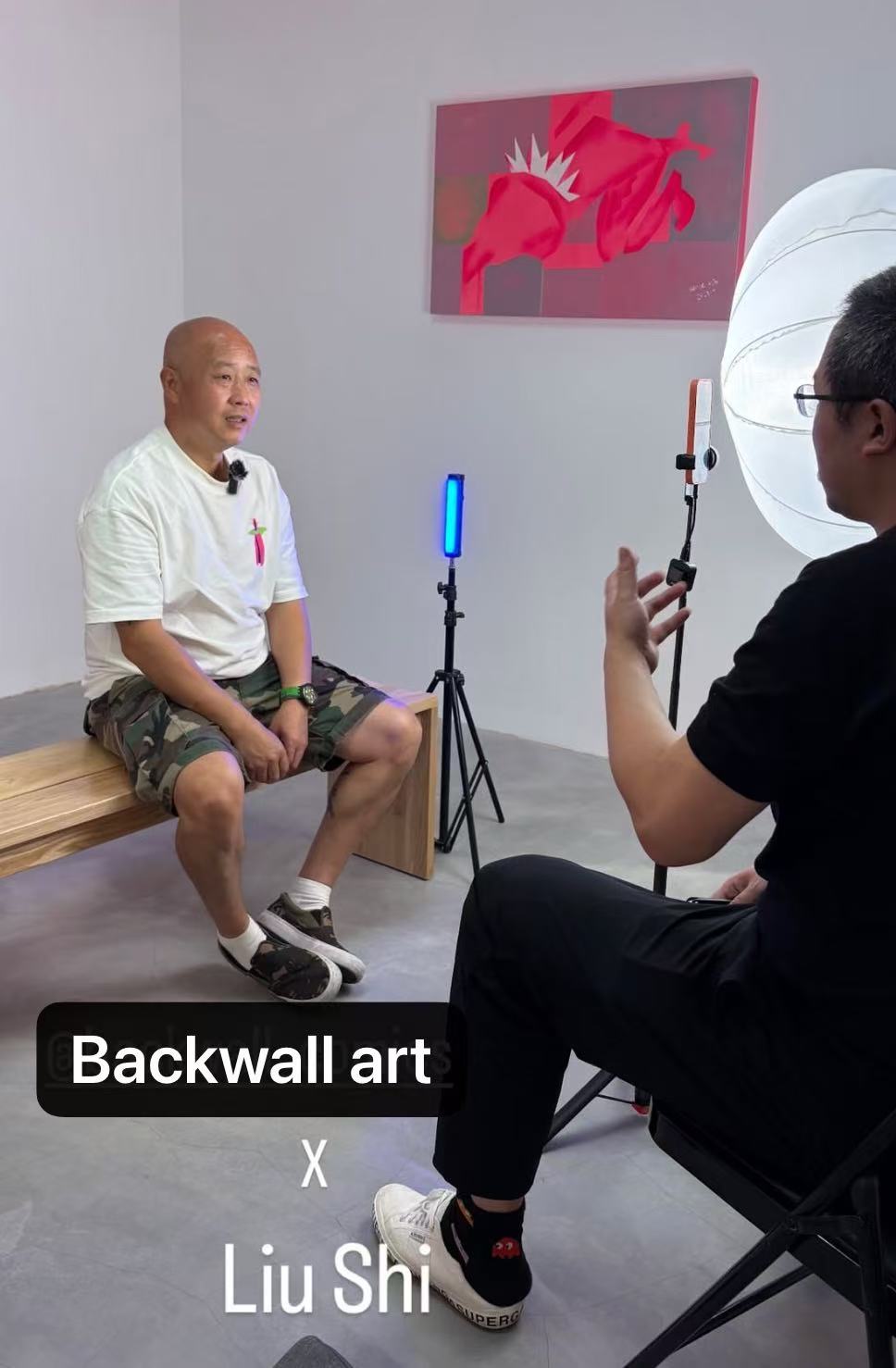
  • Liu Shi: From a Soldier’s Dream to the Freedom of Abstract Painting

    Liu Shi: From a Soldier’s Dream to the Freedom of Abstract Painting

    Interview & Text by: Tan Xiaozheng (Editor-in-Chief, BACKWALL)
    Location: FAUN Gallery, Chengdu
    Date: October 14, 2024

    On a sunny afternoon in Chengdu, artist Liu Shi sat quietly under the soft light of FAUN Gallery, speaking slowly and calmly about his forty-year journey with painting. There was nothing exaggerated about the way he talked—just like his paintings, his words carried the weight of time: honest, stubborn, and free.

    “At first, I wanted to be a soldier.”

    “I actually wanted to join the army when I was a kid,” Liu said with a laugh. “Several of my relatives were soldiers. But because of my father’s political background, that path was closed to me.”

    He admitted that as a boy, he didn’t like painting at all. “Back then I thought art was for soft guys. Soldiers with guns—that was real man stuff.”

    But his father insisted, guiding him step by step into art. By middle school, Liu had enrolled in Chengdu No. 25 High School, where he met his first real mentor, Li Jixiang, a painter active during China’s ‘85 New Wave’ movement. “That was the first time I truly fell in love with painting,” he said.

    Youth and Idealism: From Sichuan Fine Arts Institute to Abstract Expression

    In 1996, Liu entered the Sichuan Fine Arts Institute. It was an era dominated by realism, yet he was drawn to abstract expressionism.

    “When some foreign artists came for exchange, it really shook me up,” he recalled. “Out of maybe fifteen classmates, I was the only one painting abstract. I just wanted to do something different.”

    But reality hit hard after graduation. “I thought I’d serve the country after college,” he said, “but I couldn’t even pay my rent.”

    He worked part-time at a business college in Chengdu, earning 180 yuan a month, saving every bit to buy paint. “Those were the years when ideals collided head-on with reality.”

    The Blue Roof Years: Freedom and Loss

    By 2004, Liu had joined Blue Roof Art District, a legendary place for Sichuan’s contemporary artists. “Everyone was broke but pure,” he laughed. “We painted, debated, and drank together every day.”

    Then disaster struck. After the 2008 Wenchuan earthquake, floods in 2009–2010 destroyed nearly 70% of his work. “That day, I went crazy,” he said. “I even posted on Weibo: ‘God asked me if I’d lost my mind.’ I didn’t paint for half a year after that.”

    The loss became a turning point. “I started questioning everything—what is art, really? Is it worth betting my whole life on it?”

    Refusing Representation: Staying Wild and Independent

    “In 2006, a Beijing gallery offered to represent me,” he said, “but they wanted me to make things that would sell. I turned them down.”

    His tone stayed calm but firm. “Art shouldn’t be controlled by sales logic.”

    Since then, Liu has handled most of his own shows. “I once saw FAUN Gallery’s account on WeChat, left a message: ‘Would you like to collaborate?’ They replied the next day, we added each other on WeChat, and three days later the show was set.”

    “I don’t think self-recommending is embarrassing,” he added. “It’s confidence. Western artists do it all the time—why can’t we? Putting yourself out there honestly is a kind of strength.”

    The Art Scene and Its “Rivers and Lakes”

    When asked about the Chengdu art world, Liu smiled slightly. “Anywhere there are people, there’s jianghu—the rivers and lakes,” he said, referring to the Chinese word for social undercurrents and hidden politics.

    “I realized a lot of relationships were just surface-level. So I became more independent, stopped hanging around the scene.”

    He still respects Blue Roof for what it gave him, but he added, “Now I’d rather be one of the old Blue Roof guys—unaffiliated, unclassified.”

    “Not a Contemporary Artist”—Just an Artist

    “I’ve never labeled myself a ‘contemporary artist,’” Liu said. “I’m just an artist. Since I was a kid, maybe I was destined to live for art.”

    His paintings often feature soldiers, wars, and tension—echoes of his childhood dream. “I’m not painting violence,” he explained. “I’m painting power. Honesty in conflict.”

    Epilogue: Painting as Faith

    As the interview wrapped up, Liu spoke softly:
    “Painting, to me, is a form of faith. I don’t live off it—I live through it.”

    From a boy who dreamed of the army to an artist who insists on freedom; from canvases ruined by floods to the courage to knock on new doors—Liu Shi’s story, like his paintings, doesn’t please or explain. It simply stays true to itself.

     Postscript

    At FAUN Gallery, Liu’s latest works radiate a strange duality—both violent and tender. That tension is his true color, forged over time. In a noisy, distracted world, he remains proof that an artist can stay awake and burn bright.

  • Interview with Yanze Xiong: When Art Returns to Life, We Rediscover Ourselves

    Interview with Yanze Xiong: When Art Returns to Life, We Rediscover Ourselves

    Interview / Tan Xiaozheng (BACKWALL Editor-in-Chief)
    Interviewee / Yanze Xiong (Artist & Designer)

     From London Back to Tradition

    Yanze Xiong’s studio in Chengdu feels quiet and disciplined — but beneath that calm, there’s a kind of fiery order.

    He graduated from the University of the Arts London and the Royal College of Art, where he studied under British design legend Neville Brody.

    During his eight years in the UK, he worked on design projects for Alexander McQueen, the British Library, and the V&A Museum, and even collaborated with artist Xu Bing.

    But it was his deep connection to Chinese culture that pulled him back home.
    After returning, he taught at the Central Academy of Fine Arts and collaborated with brands like Wuliangye and Xijiu, bringing traditional aesthetics into contemporary design.

    “What I really care about,” he says,
    “is how our generation can redefine what ‘Chinese aesthetics’ means — in our own language.”

     “Miaohua”: A Bloom Between Cultures and the Mind

    “Miaohua” — literally “wonderful flower” — is the series Xiong has been developing for years.
    It blends Buddhist motifs, mandalas, and sacred geometry, creating imagery that feels both ancient and cosmic.

    “‘Miao’ in Daoist philosophy means harmony — every dimension in balance.
    ‘Hua’ means both flower and flourishing life.
    To me, Miaohua represents a state of inner abundance.”

    That “abundance,” he explains, isn’t just an artist’s idea — it’s something everyone experiences when they stop rushing to define themselves and allow life to grow in its own rhythm.

     Creation as Realignment

    Many of Xiong’s works were made outdoors — in the mountains, forests, or while camping.

    “Painting helps me realign myself,” he says. “Every piece is like calibrating the compass of who I am.”

    For him, art is an exchange of energy with the world.
    “In a fast-paced society, we’re constantly defined by outside voices.
    Creating slows me down. It helps me feel my own rhythm again.”

    He believes everyone needs their own kind of “creative time” — not necessarily painting, but something that allows you to reconnect with yourself: walking, writing, cooking, or simply thinking in silence.

     When Art Enters Daily Life

    “Miaohua” isn’t just an art series — it has also grown into a lifestyle brand called Jipin.

    “I wanted art to return to daily life — not just hang on museum walls.”

    He applies the “Miaohua” visual language to scarves, cups, and homeware — turning art into something you can actually use.

    It’s his quiet way of challenging the distance between contemporary art and ordinary people.
    True beauty, he says, isn’t about grand concepts — it’s about what we can live with, touch, and feel every day.

     Rethinking “Sharing”

    Xiong used to be a minor internet celebrity, with over 100,000 followers on Weibo.
    Then, one day, he deleted everything.

    “Back then, I cared too much about what others thought.
    Now I think sharing shouldn’t be about exposure — it’s about preserving something worth remembering.”

    In an age obsessed with visibility, his silence feels almost radical.
    He’s not retreating — he’s returning to the starting point: creation itself.

     A Word for Young Creators

    “Don’t let yourself be defined too early.
    The future won’t belong to single-skill specialists — it’ll belong to people who can think across disciplines and respond to real problems.”

    He sees design and creation as tools for understanding life itself.

    “Creating isn’t about escaping reality — it’s about facing it with more clarity and empathy.”

     Closing Thoughts

    On the surface, Miaohua is a flower — but for Xiong, it’s a metaphor.
    It’s what happens when life frees itself from definition and begins to grow again.

    Maybe each of us, in our own way, is also waiting for that quiet, personal bloom — our own Miaohua.